Malta Is More Than a License
June 4, 2026
by Julie Courte
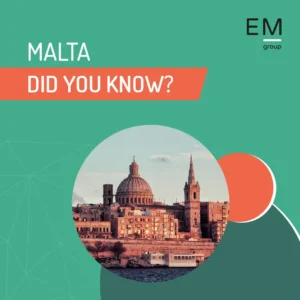
The Malta Gaming Authority (MGA) license is widely regarded as the Gold Standard in iGaming regulation in Europe. However, in a market where 304 companies hold 312 active licenses, it no longer serves as a differentiator — it is the price of entry.
If your Malta strategy begins and ends with obtaining a license, you are already behind.
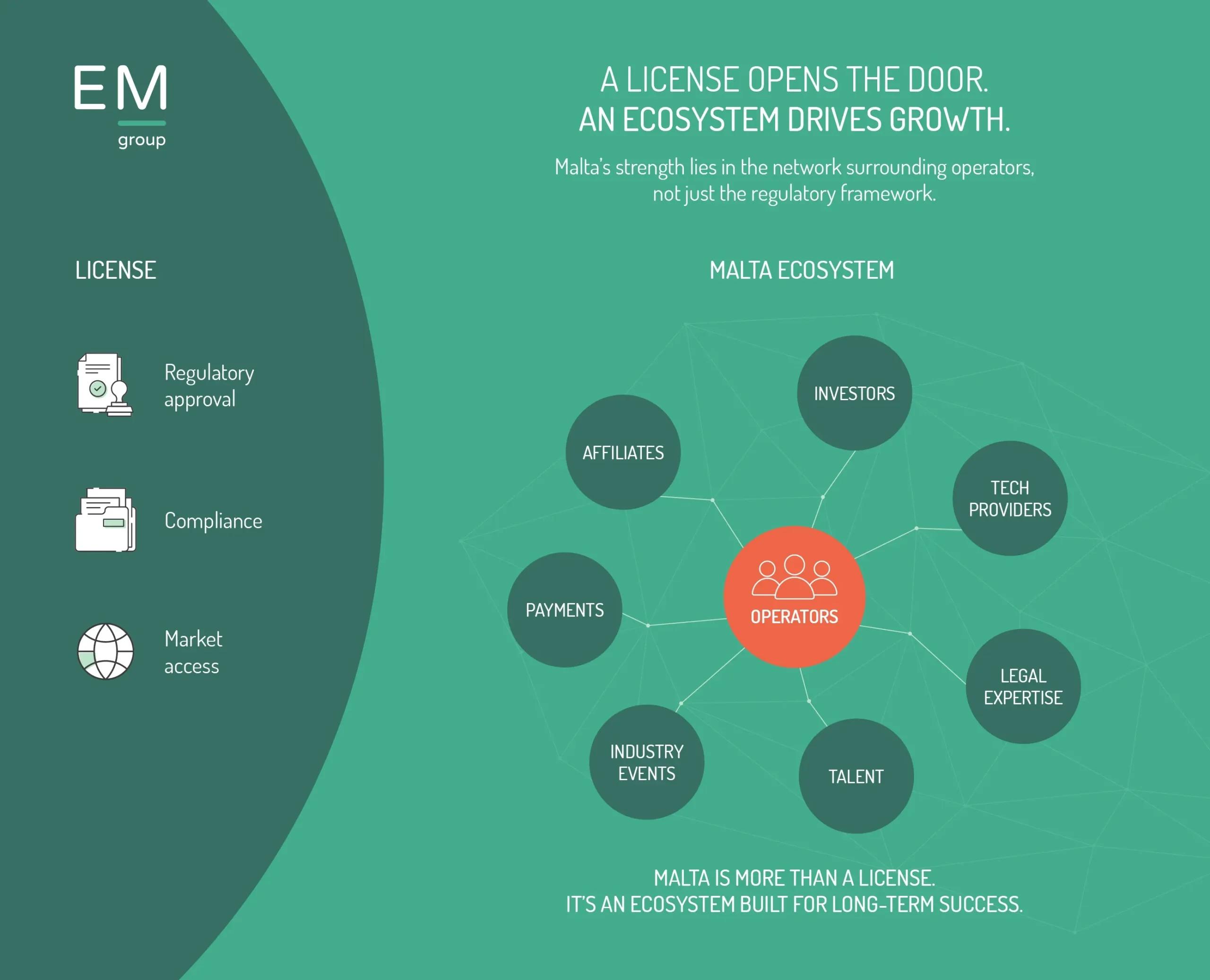
Malta's true value as an iGaming hub lies in what follows: access to talent, deep industry knowledge, a mature operational ecosystem, multi-jurisdictional opportunities, and the relationships that ultimately determine whether a business succeeds in short term or sustains its edge over the long run.
We have supported iGaming operators from Malta since 2014. Here is what you actually need to know.
The MGA License: A Baseline, Not a Strategy
Malta is widely recognized as a pioneer in iGaming regulation — the first EU member state to introduce a comprehensive regulatory framework for online gaming, back in 2004. That track record has built a strong reputation that continues to matter today.
An MGA license strengthens your credibility with banks, payment providers, and commercial partners. However, in a mature and highly developed market, the possession of an MGA license alone may no longer be sufficient to differentiate operators.
According to the MGA's H1 2025 Interim Report, the MGA received a record 28 new license applications in the first half of 2025 alone — the highest figure recorded for a single half-year period. At the same time, the sector's most established operators have built a presence in Malta averaging over 13 years. Licensing is clearly a long-term commitment, not a short-term objective.
The key question, therefore, is not simply whether a license can be obtained — but whether your business is prepared for the ongoing compliance, operational and regulatory requirements that follow. Operators who treat licensing as the endpoint often underestimate the time and cost to stay compliant as their business grows.
Malta as a Strategic iGaming Hub: The Ecosystem Advantage
Malta's strength is structural. It is not just the license — it is the entire environment built around it.
Regulatory credibility and EU market access
An MGA license provides EU-level regulatory recognition, which opens doors with European banks, payment processors, and business-to-business partners. Malta's regulatory framework is aligned with EU law, which means operators based here benefit from a level of cross-border credibility that is difficult to replicate in other jurisdictions.
A mature talent pool and industry community
Malta is home to over 14,000 gaming-sector professionals — a concentration of compliance, legal, technical, and commercial expertise developed over more than two decades. Add to that SiGMA, one of the world's most prominent iGaming industry events, and Malta offers an ecosystem of connections that punches well above its size.
A business-friendly fiscal environment
Malta offers a highly attractive and EU-compliant tax regime, featuring a full imputation system and tax refund mechanism that can reduce the effective corporate tax rate for international businesses to as low as 5% in certain structures. Combined with an extensive double tax treaty network, no withholding taxes on dividends, interest, or royalties, and a strong regulatory framework, Malta remains a leading jurisdiction for international companies and investors. Malta's tax regime for gaming companies specifically is also interesting with first-year waivers on compliance contributions for start-ups. According to the MGA's H1 2025 Interim Report, in the first half of 2025, the gaming industry gener-ated €714.4 million in gross value added (GVA) — equivalent to 6.5% of Malta's total GVA. That sustained economic contribution reflects the government's long-term commitment to keeping the sector healthy.
Malta also took steps to strengthen legal certainty for licensed operators. In 2023, Bill 55 amended the Gaming Act by inserting Article 56A, which clarifies when Maltese courts may decline to recognise and enforce certain foreign judgments against MGA licensees — on public policy grounds.
Post-Licensing: Where the Real Work Begins
Once licensed, the compliance obligations do not ease — they intensify as your operation grows. The MGA takes this seriously. In 2024 alone, it conducted 13 full compliance audits and 116 desktop reviews, issued 25 financial penalties totaling €306,250, and cancelled eight licenses. These are not abstract risks.
Key Function holders
Every MGA-licensed operator must appoint approved Key Function holders (KFH) — individuals responsible for compliance, anti-money laundering (AML), and responsible gaming. These roles carry personal accountability, and the MGA reviews them closely. Our Malta Key Function Services ensure you have qualified, experienced KFH support in place without adding permanent headcount to your payroll.
AML obligations and ongoing reporting
In 2024, the MGA and the Financial Intelligence Analysis Unit (FIAU) completed 43 AML/CFT compliance examinations, resulting in nearly €185,000 in penalties. AML health checks are no longer a box-ticking exercise — they are a live operational requirement that demands documented processes, trained staff, and regular review.
Alongside AML, operators are required to submit monthly and quarterly reports, annual audited accounts within six months of year-end, and technical compliance documentation on an ongoing basis. Our regulatory reporting services handle these obligations so your team can remain focused on the business.
Recognition Notices: Expand Without Starting Over
If your company holds a gaming license from another EU or EEA jurisdiction, you do not need a full MGA license to operate in Malta. The MGA's Recognition Notice (RN) framework allows foreign-licensed operators to service Maltese players and licensees — with the same regulatory effect as an MGA authorisation — without transferring their primary license. A common example would be a Romanian (domestic) license with a Malta recognition notice – although it can be seen throughout the EU with many other local licenses, and repeating now with Finland's new licensed market, which opens to private operators in July 2027.
RN certificates cost €5,000 per year and require annual maintenance reviews. The MGA is currently running a targeted consultation on proposed enhancements to the RN framework — a development worth monitoring closely if you are considering Malta as part of your market strategy.
The RN route is faster and less capital-intensive than a full licensing application, making it a smart first step for operators testing the Maltese market before committing to a full local presence. We help operators assess the right approach and manage the application process end to end. It is also a must-have for any company set up in Malta and licensed in a foreign EU or EEA jurisdiction.
Using Malta as a Base for Redomiciliation and Multi-Jurisdictional Growth
Malta has established itself as a natural base for redomiciliation in the remote gaming sector, particularly where structural or regulatory conditions in an operator’s existing jurisdiction become less favourable. Recent shifts in markets such as the United Kingdom, the Netherlands, and Finland have reinforced the value of having a stable, well-regulated operational base.
Malta’s regulatory framework accommodates a range of operational models. Depending on the nature and structure of your gaming activities, you can establish a presence under a full MGA license or operate via a recognition notice based on an existing EU or EEA license. In some cases, where activities fall outside the where activities fall outside the Gaming Act's licensing scope, it may be possible to establish a presence without a license — subject to a case-by-case assessment.
Beyond licensing, Malta’s well-developed ecosystem of compliance professionals, legal and technical expertise, and competitive fiscal conditions make it a compelling choice for operators planning sustainable, multi-jurisdictional growth.
Operators who build their base in Malta gain both regulatory flexibility and the surrounding infrastructure needed to scale sustainably across multiple jurisdictions.
We have been part of Malta’s gaming ecosystem since 2014 and we operate across Curaçao, the Netherlands, and Cyprus. That gives us a practical understanding of both local regulatory requirements and how Malta functions within broader international structures — so we can support you at every stage of your journey.
Your Malta iGaming Strategy Starts Here
An MGA license opens the door. What sustains your position—and enables long-term growth—is how effectively you navigate the regulatory obligations, build the right relationships, and integrate within the broader Maltese ecosystem. Malta rewards operators who take a structured approach to compliance and invest in the right local foundations.
We support you in managing that complexity, allowing you to focus on strengthening and scaling your iGaming business. Whether you are applying for an MGA license, managing ongoing regulatory requirements, or evaluating your next jurisdictional move, we provide practical, end-to-end support at every stage.
Our iGaming License Services cover the full Malta gaming license process — from MGA application through to ongoing license maintenance.
Get in touch to explore how we can support your Malta strategy.
Written by Julie Courte