World Cup 2026 Betting Behavior, Explained
July 14, 2026
Before kick-off, the U.S. sports betting industry had already reached unprecedented scale, generating $167 billion in wagers and nearly $17 billion in revenue in 2025 alone, the strongest year on record since the industry's expansion began in 2018.
Against this backdrop, the 2026 FIFA World Cup was widely expected to become one of the largest betting events ever recorded. The tournament's expanded 48-team format, North American hosting and continued growth of regulated betting markets created ideal conditions for record-breaking wagering activity. Some estimates suggest total betting volume, including both regulated and unregulated markets, could ultimately exceed half a trillion dollars globally.
With the tournament at the stage of the semi-finals, global betting activity has surpassed $50 billion, placing World Cup 2026 firmly on track to become the largest betting event in sporting history.
The numbers are impressive. Yet the most interesting story is not how much people are betting—it is why.
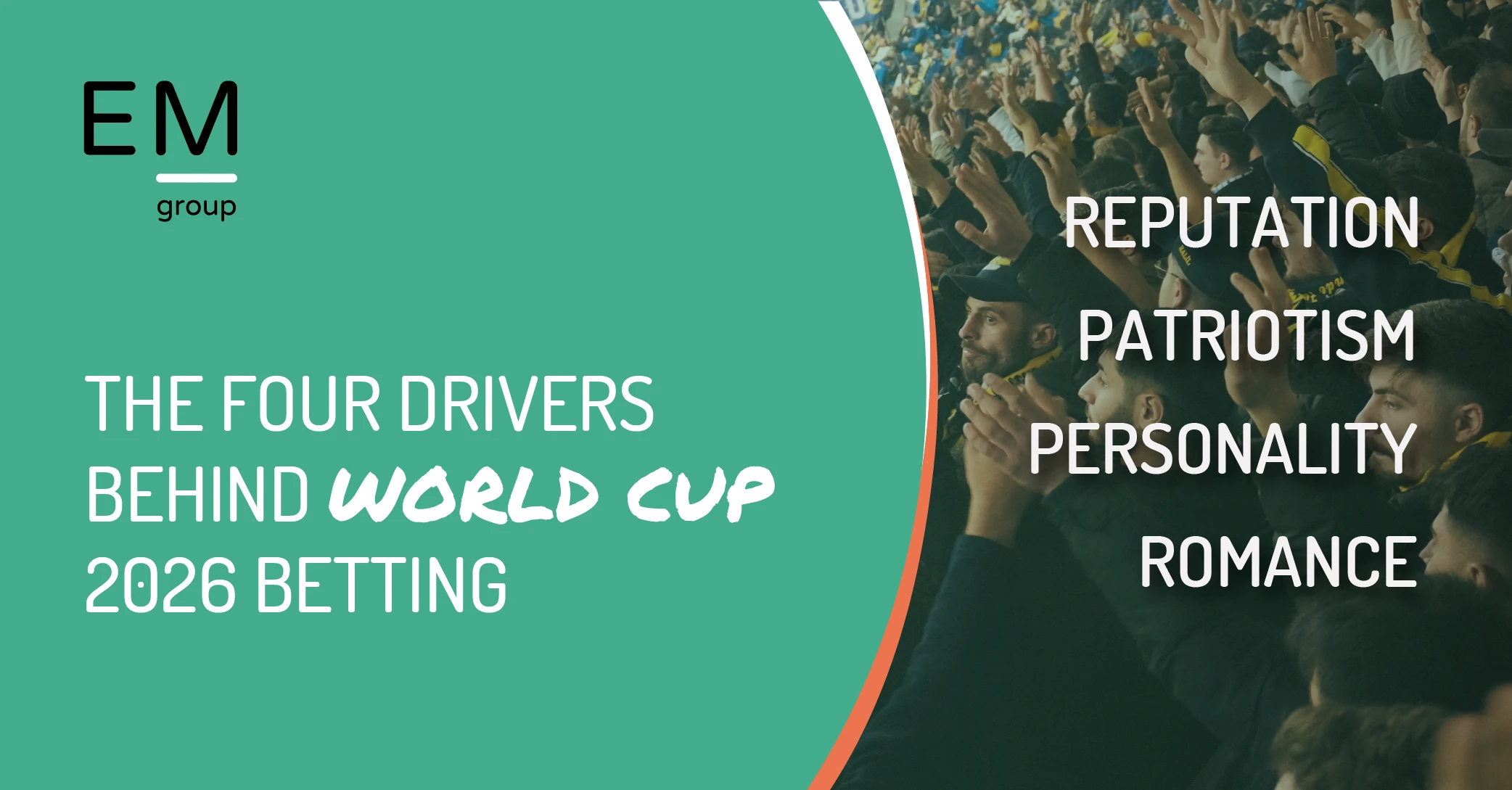
Throughout World Cup 2026, four behavioral drivers have shaped betting activity: Reputation, Patriotism, Personality and Romance. Together, they reveal how modern betting behavior is increasingly influenced by trust, identity, individuals and stories rather than probability alone.
Reputation: Why Bettors Still Back the Favorites
Before kick-off, betting markets centered around football's traditional powers.
France, Argentina, Brazil, England and Spain dominated outright winner markets, reflecting a long-standing tendency among bettors to favour proven tournament success over potential value. In a competition filled with uncertainty, reputation provides comfort.
Backing elite football nations is rarely a purely statistical decision. It is built on history, familiarity and perceived reliability.
However, World Cup 2026 quickly exposed the limits of reputation-driven betting.
The defining example came when Paraguay eliminated Germany in the Round of 32. Germany entered the match as overwhelming favorites, making Paraguay's victory one of the tournament's biggest betting surprises. France ended Paraguay's run 1-0 in the following round, closing out one of the tournament's most talked-about upsets.
Cape Verde added to the theme by stunning the world with a draw against reigning continental champion Spain. After that historic result, Cape Verde won their Round of 32 match outright and reached the Round of 16, where Argentina needed extra time to end their run, a run that turned them into one of the tournament's most talked-about fan favorites.
These results reminded bettors of a simple truth: reputation may influence markets, but it does not determine outcomes.
The expanded 48-team format has amplified this uncertainty. With more nations, more knockout fixtures and more opportunities for surprises, the traditional hierarchy of international football appears less secure than ever before.
World Cup 2026 has shown that while bettors continue to trust reputation, markets become vulnerable when reputation is mistaken for certainty.
Even so, reputation reasserted itself by the semifinal stage: France, Spain, England and Argentina, four of the five nations bettors backed most heavily before kick-off, are the last four standing, with only Brazil's earlier exit breaking the pattern.
Patriotism: How Host Nations Drive Betting Engagement
The tournament's North American setting created another powerful betting driver: patriotism.
The progression of the United States, Canada and Mexico beyond the group stages helped maintain exceptional betting engagement throughout the tournament. Matches involving host nations consistently attracted significant wagering activity, often beyond what the odds alone would justify, right up until all three co-hosts were eliminated in the Round of 16.
Patriotic betting behaves differently from traditional wagering.
Supporters are not merely backing a result; they are backing their country. A bet on a national team is frequently driven as much by identity as by expectation.
That emotional connection helps explain why international tournaments consistently generate betting activity that exceeds domestic competitions.
World Cup 2026 has amplified this effect through three host nations and widespread access to regulated sports betting across North America, creating one of the most engaged betting audiences ever seen during a football tournament.
Patriotism did not stay confined to bettors, either. Before England faced Norway in the quarterfinal, British Airways and Norwegian Air made their own wager: the airline representing the losing nation would swap its Instagram profile picture to its rival's logo for a day. When England won 2-1 in extra time, Norwegian Air honored the bet, and millions watched a football result play out in airline branding.
Personality: How Star Players Move Betting Markets
While teams continue to dominate headlines, World Cup betting is becoming increasingly player-driven.
Historically, betting focused on match winners and tournament champions. Today, bettors are engaging heavily with individual performance markets, including Anytime Goalscorer, First Goalscorer and Golden Boot betting.
At the centre of this trend are football's biggest personalities.
Kylian Mbappé has become one of the clearest examples of personality-driven wagering. Confidence in France has translated directly into confidence in its biggest star, making him one of the most heavily backed players across multiple betting markets.
Lionel Messi represents a different form of betting behavior.
Wagers involving Messi are driven as much by narrative and legacy as by current performance. Every appearance carries the possibility of another defining moment in one of football's greatest careers, creating betting interest that extends well beyond traditional analysis.
Heading into the semi-finals, that personality-driven betting has only intensified: Mbappé and Messi are now tied atop the Golden Boot race, with Jude Bellingham and Erling Haaland (now eliminated) close behind.
This phenomenon illustrates how personality can shape market behavior. Just as bettors gravitate towards famous teams, they also gravitate towards famous players.
Recognition creates confidence. Familiarity creates trust.
In many respects, personality betting is simply reputation betting at an individual level.
Romance: Why Underdog Stories Like Curaçao Attract Bettors
Perhaps the most fascinating trend of World Cup 2026 has been the rise of the romance bet.
A romance bet is not driven primarily by probability. It is driven by narrative. People place these wagers because they want a story to continue.
No nation embodied this more than Curaçao.
As the smallest nation ever to qualify for a FIFA World Cup, Curaçao arrived carrying one of the competition's most compelling stories. Few expected them to challenge for the trophy, yet that was never the attraction.
Neutral bettors backing Curaçao were participating in a historic sporting journey as much as predicting a result. Although their tournament ended in the group stage, qualification alone transformed them into one of the defining stories of World Cup 2026.
Cape Verde generated a similar response.
Entering the tournament as debutants and outsiders, they exceeded expectations and became one of the competition's favorite underdog stories. Holding Spain and reaching the knockout stages transformed them from long shots into fan favorites.
Paraguay benefited from the same phenomenon after their shock victory over Germany, while Morocco carried the romance bet furthest of all, beating the Netherlands and Canada to reach the quarterfinals before France ended their run.
Once an underdog produces a defining moment, the market changes. Bettors begin supporting not only the next result but also the possibility that the story still has another chapter to tell.
People are no longer wagering solely on who they believe will win.
Increasingly, they are wagering on who they want to see succeed.
The EM Group Perspective
World Cup 2026 may become one of the largest betting events ever recorded.
Yet its most valuable lesson is not financial. It is behavioral.
The tournament has demonstrated that modern betting decisions are influenced by far more than statistics, probability and market pricing. Bettors increasingly engage with reputation, patriotism, personality and romance.
They back reputation because they trust it.
They back patriotism because they identify with it.
They back personality because they admire it.
And they back romance because they want to believe in something improbable.
For operators, understanding these behavioral drivers presents both an opportunity and a responsibility.
The same drivers of engagement also elevate expectations for player welfare, responsible gaming, financial crime prevention, and regulatory adherence. As customer journeys become increasingly influenced by emotion and narrative, operators must ensure that growth is matched by governance and safeguarding frameworks that scale with it.
EM Group supports operators across multiple jurisdictions with tailored solutions in corporate governance, AML, responsible gambling compliance, and banking. By safeguarding regulatory integrity and operational resilience, we empower operators to focus on their core objectives: fostering player loyalty, understanding behavioural trends, and delivering sustainable, responsible growth.
Bettors are no longer just backing outcomes; they are backing stories. For operators, the real work is building that engagement on frameworks that are sustainable, responsible and compliant. The operators who get this right will not just know what people are betting on. They will know why, and what it takes to support it responsibly.
EM Group has existed since 2005, that is over 2 decades of experience of providing iGaming Services from Curacao, Malta and the Netherlands to the most recognizable operators across the world.
Frequently Asked Questions
How much is being wagered on the 2026 FIFA World Cup?
With the tournament at the stage of the semi-finals, global betting activity has surpassed $50 billion, putting World Cup 2026 on track to become the largest betting event in sporting history. In the United States alone, the sports betting industry has generated more than $700 billion in cumulative handle and over $60 billion in operator revenue since legal sports betting expanded nationwide in 2018.
What are the four behavioral drivers shaping World Cup 2026 betting?
Betting activity throughout the tournament has been shaped by four forces: reputation (bettors backing proven football nations), patriotism (host-nation fans backing their own teams), personality (bettors following star players like Mbappé and Messi), and romance (bettors backing underdog stories for the narrative rather than the odds).
Why do bettors back underdog teams like Curaçao and Cape Verde?
Analysts describe this as the "romance bet," a wager placed because bettors want a story to continue rather than because the odds favor it. Curaçao's run as the smallest nation ever to qualify, and Cape Verde's draw against Spain, turned both sides into fan favorites regardless of the final result.
What does narrative-driven betting mean for regulated operators?
As betting decisions become more influenced by emotion and identity, operators face new expectations around player welfare, responsible gaming, financial prevention and regulatory adherence. EM Group supports operators through tailored solutions in corporate governance, AML, responsible gambling compliance and banking.
Written by Arran McCarthy