World Cup 2026 will rewrite iGaming — and Curaçao is ready
May 15, 2026
The FIFA World Cup has long been one of the most powerful global catalysts for sports betting activity. Every four years, it concentrates global attention, national pride, and competitive tension into a single prolonged surge of engagement.
World Cup 2026, however, represents something structurally different. It marks a turning point for the global iGaming industry—not only by scale, but because it arrives at a moment of tighter regulation, broader market access, and far more mature betting infrastructures.
Our iGaming License Services cover the full Curaçao licensing process — from application to go-live — so operators are ready before the tournament begins.
The Benchmark: What the World Cup 2022 verified
World Cup Qatar 2022 reset expectations for digital betting performance. Global wagers reached approximately USD 35 billion, representing a 65% increase compared with the 2018 World Cup (Barclays; H2 Gambling Capital, 2022).
In the United States alone, betting handle reached roughly USD 1.8 billion, driven by the rapid post-PASPA expansion of legal sports betting. These figures were cited by the American Gaming Association and widely reported by CNBC and CBS News during the tournament (AGA, 2022).
Engagement, Not Just Volume
Beyond headline wagering totals, audience behavior tells an even more important story. During Qatar 2022, operators reported matchday betting traffic increases of between 30% and 50% compared with typical football weekends, according to operator disclosures summarized by H2 Gambling Capital (2022).
Live, in-play betting now dominates tournament activity. Roughly 64% of all bets were placed on matchday or during live play, reflecting the shift toward mobile-first wagering and real time odds feeds (H2 Gambling Capital, 2022).
Looking ahead, 60% of global football fans plan to place online or mobile bets on World Cup 2026, and 19% expect to do so for the first time — an acquisition rate notably higher than at other sports events.
These results were achieved under relatively constrained conditions: just 64 matches, uneven regulatory access in emerging markets, and betting infrastructure still transitioning toward maturity. In hindsight, World Cup 2022 looked more like a group stage than the final.
Why World Cup 2026 Changes Everything
World Cup 2026 fundamentally reshapes the commercial landscape. FIFA has expanded the tournament to 48 teams and 104 matches, a more than 60% increase in total fixtures, making it the largest World Cup in history (FIFA, 2025).
The expanded format extends the tournament across 40 days, giving operators significantly more time to acquire, retain, and activate players throughout prolonged group stages.
Crucially, matches will be hosted across the United States, Canada, and Mexico, placing the majority of fixtures in commercially favorable time zones. This alignment synchronizes global viewership with peak wagering hours across Europe, Africa, and the Americas, significantly boosting live and in-play betting potential (FIFA, 2025; FOX Sports, 2026).
Industry forecasts reflect this expansion to translate directly into wagering volume. Multiple analysts project that global World Cup 2026 betting handle could exceed USD 150 billion, more than four times the volume of 2022, with betting-related revenues to surpass USD 10 billion over the tournament window (FocusPredict, 2026; ChaseYourSport, 2026).
As highlighted during the World Cup 2026: Betting Predictions and Market Movers seminar at SBC Malta, speakers emphasized that the central challenge for operators will not be driving traffic, but sustaining player engagement. Success during the tournament will depend on an operator’s ability to deliver a seamless, integrated experience that allows players to watch matches and place bets simultaneously, across multiple time zones, combining live content, real-time data, and frictionless in-play wagering into a single user journey (SBC Malta, World Cup 2026: Betting Predictions and Market Movers session).
Where the World Cup Betting Money Comes From
The geographic mix of World Cup betting continues to evolve.
The United States has emerged as the single most important growth engine. During Qatar 2022, an estimated 20.5 million American adults placed bets on the tournament, generating approximately USD 1.8 billion in handle (AGA, 2022). By 2023, the broader U.S. online gambling market was generating around USD 66 billion in annual revenue, according to industry tracking firms and state-level reporting (Statista, 2024).
The United Kingdom remains a structural pillar of global iGaming, with approximately USD 19 billion in annual online gambling activity and online channels accounting for about 56% of total gambling spend. Football continues to dominate sports-betting volume in the UK (UK Gambling Commission, 2024).
Australia leads the world in per-capita gambling participation, with adult participation exceeding 70%, while Germany, France, and Italy round out the mature European core where football remains the dominant wagering vertical (OECD, 2024; European Gaming & Betting Association, 2024).
The fastest growth, however, is occurring elsewhere. Brazil and the wider Latin American region are experiencing rapid expansion, supported by the adoption of mobile payments such as Pix. Globally, Europe accounts for about 49% of online gambling revenue, while North America and Latin America are pulling the highest growth multiples in tournament-linked activity.
For operators, the implication is clear: maturity delivers scale, but emerging markets deliver velocity – and licenses that travel well across both are increasingly decisive.
iGaming and the Modern World Cup Ecosystem
Betting is no longer adjacent to the World Cup—it is embedded within the event’s commercial structure.
As early as the 2018 World Cup, betting-related advertising accounted for approximately 17% of total tournament advertising spend, according to media monitoring agencies (Kantar Media, 2018). By 2026, integration has deepened further.
FIFA has awarded exclusive global betting data and streaming rights to Stats Perform, enabling regulated bookmakers to offer official live odds, micro-markets, and direct video streams sourced from the competition itself (Stats Perform, 2023; FIFA, 2024).
With scale comes scrutiny. FIFA strictly prohibits players, referees, and officials from betting on tournament matches due to manipulation and integrity risks (FIFA Integrity Code, 2024). Regulators in mature markets have also noted elevated problem-gambling risk during major tournaments, particularly among younger and first-time bettors (UKGC, 2024; WHO, 2023).
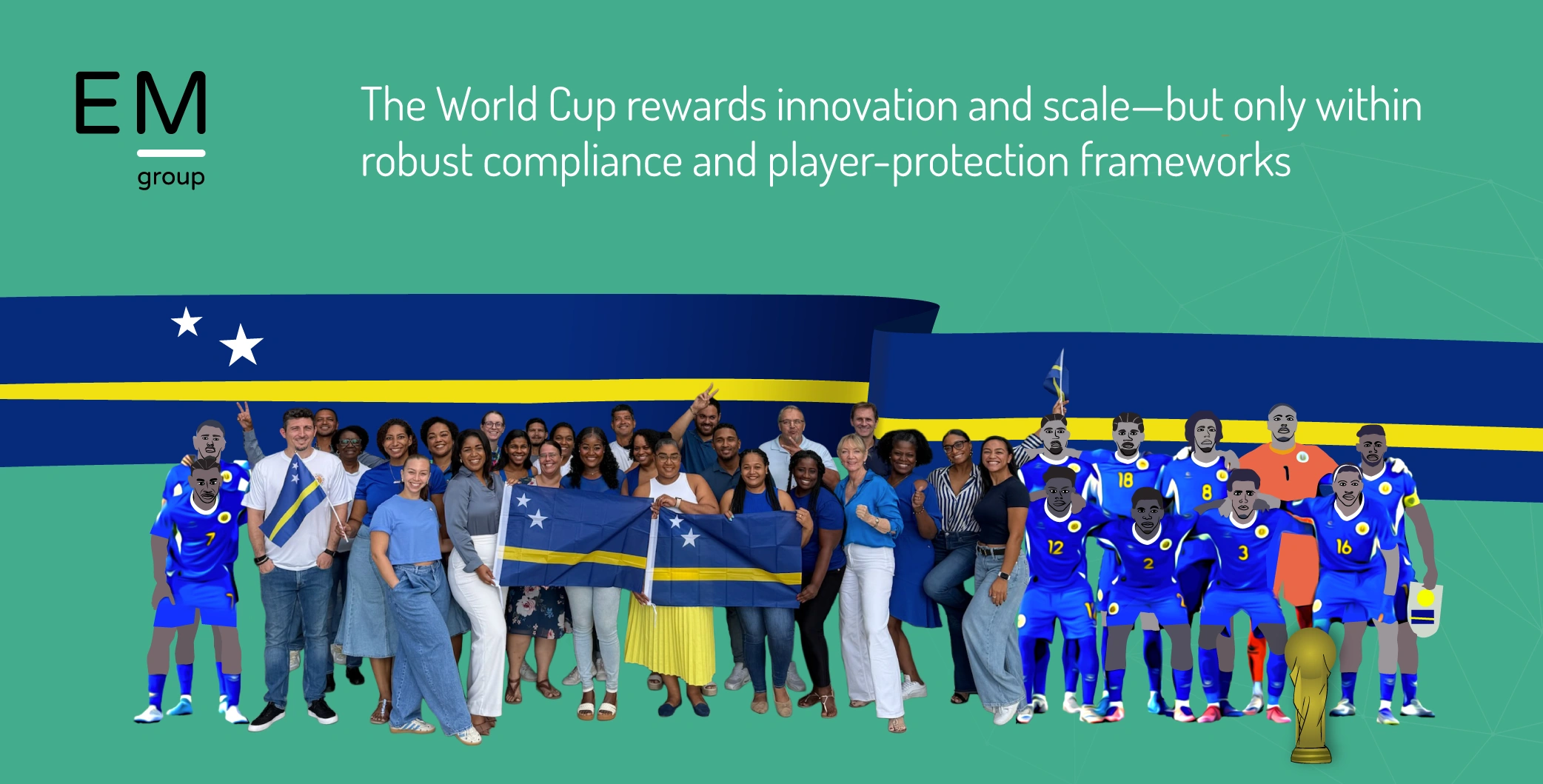
The message to operators is unambiguous: the World Cup rewards innovation and scale—but only within robust compliance and player-protection frameworks.
Which Licenses Will Carry Operators Through 2026
As World Cup activity intensifies, the global iGaming market consolidates around a limited number of licensing regimes.
The UK Gambling Commission (UKGC) remains the consumer-protection benchmark and is mandatory for operators marketing or sponsoring within the United Kingdom (UKGC, 2024).
The Malta Gaming Authority (MGA) underpins many of the largest pan-European brands and retains strong recognition across regulated markets (MGA, 2025).
Curaçao, however, occupies a strategically distinct position. Historically, favored for emerging, cross-border, and crypto-friendly markets, the jurisdiction has strengthened its credibility following the introduction of the National Ordinance for Games of Chance (LOK). This reform replaced the old sublicense model with direct regulator-issued licenses, enhanced AML obligations, and clearer compliance oversight (Curaçao Gaming Authority, 2024; Yogonet, 2026)
Industry analysts note these reforms have materially improved Curaçao’s international standing, positioning it as a viable gateway for operators targeting emerging and cross-border markets ahead of World Cup 2026 (GFLO Consultancy, 2026; The Yucatan Times, 2026).
In a fitting coincidence, Curaçao will also make history in 2026 as the smallest nation ever to officially qualify for a FIFA World Cup, placing the island simultaneously on the pitch — and behind the betting platforms powering global fan engagement (FIFA, 2026; FOX Sports, 2026).
And on a purely cultural note: if you have not yet secured the Curaçao World Cup Adidas away shirt, now is the time. It may well become the most valuable fashion collectible in iGaming and the World Cup history books, narrowly beating the classic “conference jacket nobody wears outside of events.”
What Bettors Will Be Wagering On
Across recent tournaments, wagering platforms have been remarkably consistent. Match Result (1X2) markets generate the highest volume, with Over/Under Goals typically accounts for around 25% of all bets.
In-play micro-markets — such as next goal, next corner, next card — continue to grow faster, driven by mobile usage and advanced live-data feeds (H2 Gambling Capital, 2022; Stats Perform, 2024).
Among player markets, one bet consistently dominates: The Golden Boot (top goalscorer). It remains the most heavily wagered player-specific market at every World Cup due to strong star narratives and long tournament duration. Early 2026 favorites include Kylian Mbappé, Harry Kane, Erling Haaland, and Lionel Messi, according to pre-tournament odds lines published by major bookmakers (OddsChecker, 2025).
Turning Tournament Momentum into Long-Term Value
World Cup 2026 is not merely a six‑week traffic spike. For iGaming operators, it is a launchpad for long‑term player acquisition, brand positioning, and regulatory resilience.
Operators that prepare early—both structurally and jurisdictionally—stand to convert World Cup exposure into durable enterprise value long after the final whistle.
This is where we play a pivotal role. We help operators align licensing, structuring, and compliance frameworks so that tournament momentum becomes sustainable growth.
Whether you want to discuss Curaçao’s iGaming opportunities, the island’s history-making football fairytale, or simply where to find the coolest football shirt on the planet, we are always happy to help.
Written by Arran McCarthy