Why Gaming and Digital Businesses Are Relocating to Malta in 2026
17 August , 2026
by EM Group
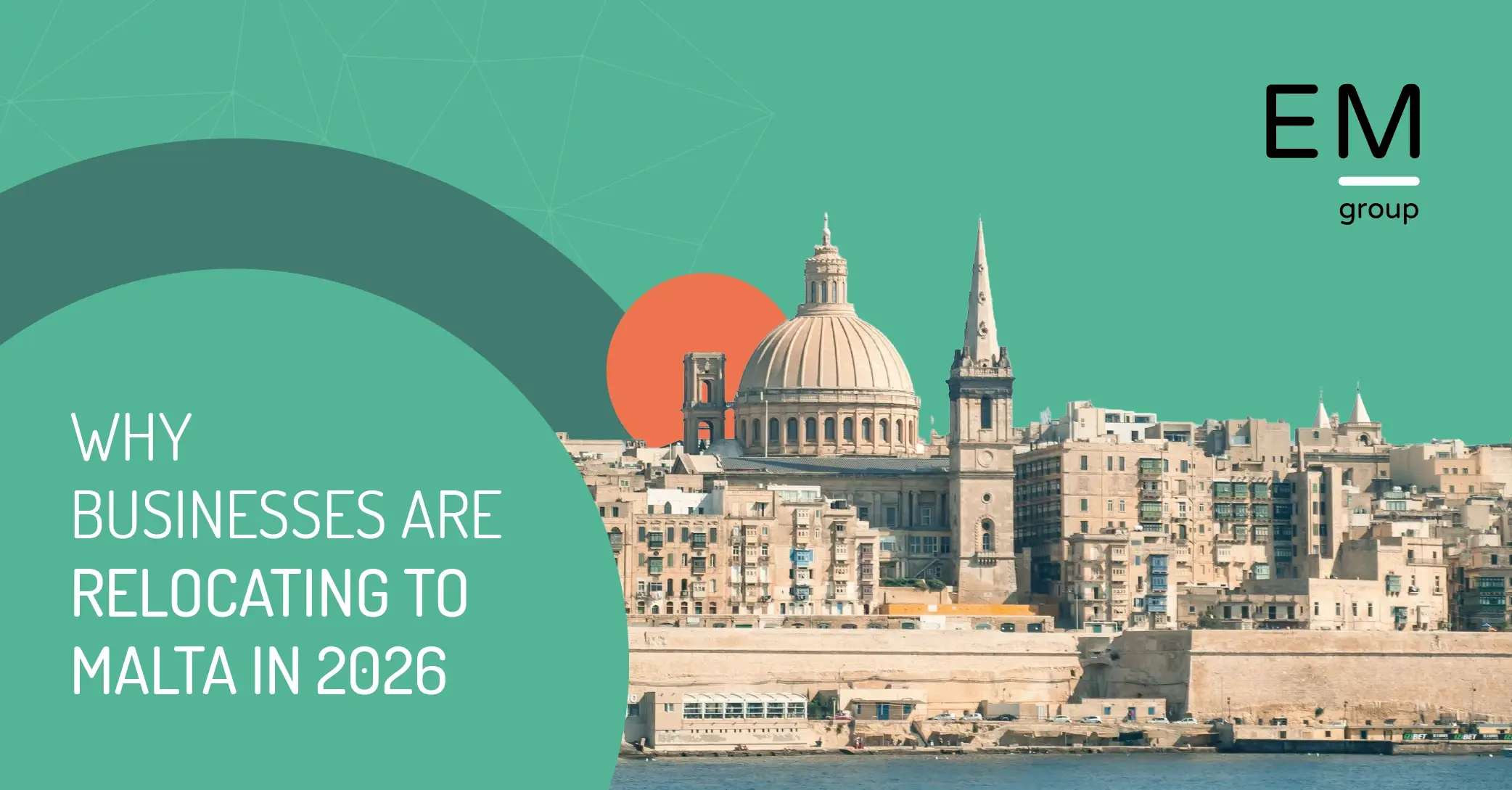
Malta continues to attract iGaming, SaaS, fintech, and digital businesses looking for more than a reputable jurisdiction. In 2026, the conversation has shifted from tax and incorporation toward something more important: regulatory credibility, banking access, and long-term operational stability.
This article covers the eight factors driving that shift — why regulatory certainty now outweighs cost, what a genuine EU presence changes for banking and payments, and what a relocation actually requires beyond incorporating a company.
What Is Driving Relocation in 2026
Gaming and digital businesses relocating to Malta in 2026 gain access to the Malta Gaming Authority (MGA) licensing framework, EU market access, a banking ecosystem that recognizes the MGA license, and a professional talent pool built over two decades of iGaming growth. The relocation decision is no longer primarily about cost. It is about building a business structure that payment providers, affiliates, and institutional partners take seriously.
As we covered in our article on Malta as a strategic iGaming hub, an MGA license is the price of entry — not a strategy in itself. The real question is how to build the structure around it correctly. This article focuses on the practical side of that move: the eight factors driving Malta relocations in 2026, and what each of them requires.
Why Regulatory Certainty Is the Primary Driver in 2026
Businesses used to choose jurisdictions based on speed and cost. By 2026, that calculus has shifted. Banking instability, payment provider scrutiny, and affiliate caution toward lightly regulated operators have made the quality of the regulatory environment the deciding factor.
The MGA Gaming Act of 2018 consolidated Malta's earlier Remote Gaming Regulations into a single, coherent framework. It covers both B2C Gaming Service licenses and B2B Critical Gaming Supply licenses. The result is predictability — an environment operators, banks, and partners understand. That matters commercially: it reduces friction with payment processors, strengthens affiliate relationships, and supports institutional engagement. For operators targeting European customers, an EU base is becoming a commercial prerequisite, not a preference.
How Malta Helps Operators Consolidate Complex Group Structures
Operating across multiple jurisdictions compounds compliance overhead fast. Every additional entity means separate banking, separate AML procedures, separate reporting obligations. As seen numerous times with serious businesses, Malta becomes the operational hub that simplifies this: a Maltese holding and operating company anchors EU licensing, centralizes governance, and gives the group a stable platform to manage everything else from.
Malta law also supports redomiciliation — the transfer of a company's legal domicile into Malta without dissolution or loss of corporate continuity. Existing contracts, banking relationships, and legal agreements remain valid.
What Does an EU Presence in Malta Actually Provide?
Banking relationships, payment provider access, and affiliate partnerships all respond to regulatory jurisdiction. Operators without an EU-regulated structure face sustained friction that operators inside the EU framework largely do not. Malta is a full EU member state. It is English-speaking, operates under a legal framework aligned with GDPR and EU anti-money laundering directives, and sits inside the EU payments infrastructure. For operators based in other jurisdictions, that removes friction they deal with constantly.
One practical note: the Malta Business Registry (MBR) only accepts company incorporation applications through registered Corporate Services Providers — this is a regulatory requirement, not an administrative preference.
Why Banking and Payments Are Jurisdiction Decisions
Ask any operator who has tried to open a business bank account without an EU license, and the experience can vary significantly — but often includes enhanced due diligence, delays, restrictions, or declines. The MGA license changes that. Banks and payment service providers recognize it as a credible regulatory framework — and most will work with MGA-licensed businesses where they would not with operators licensed elsewhere. The same applies to payment processors: MGA oversight standards align with what financial institutions require to extend reliable merchant accounts.
For this reason, the banking question is best addressed during the incorporation and licensing process, rather than treated as an afterthought.
Relocation to Malta Is More Than Incorporating a Company
The most consistent error businesses make is treating company incorporation as the primary task. It is one step in a larger project. Our article on Malta as a strategic iGaming hub covers what those post-licensing obligations look like in practice.
From a relocation standpoint, the full picture includes licensing applications, local substance requirements, the appointment of MGA-approved key function holders, directorship and governance structures, tax registrations, banking arrangements, and the ongoing compliance program the MGA license requires. MGA-licensed B2C operators must appoint eight individually MGA-approved key function holders: a Chief Executive Officer, a Chief Operations Officer or Chief Financial Officer, a Compliance Officer, a Legal Officer, a Money Laundering Reporting Officer (MLRO), a Data Protection Officer, a Chief Technology Officer and Information Security Officer, and an Internal Audit function. B2B operators require seven of the same — the MLRO is the only role exclusive to B2C licensees, as it applies specifically to operators handling player funds directly. EM Group can help with this from the application to license approval and throughout the active license’s ongoing regulatory requirements - all through a single point of contact.
Why SaaS, Fintech, and Digital Businesses Are Also Choosing Malta
Malta's appeal extends well beyond licensed gaming operators. SaaS businesses, affiliate groups, software developers, and payment companies are making the same move. The reasons are structural: EU market access, a stable English common law framework, an English-speaking professional environment, and a jurisdiction that banks recognize.
The iGaming sector generated approximately €1.386 billion in gross value added in 2024 , contributing to approximately 11-12% of Malta’s economy when direct, indirect, and induced effects are included — a figure cited by Malta Gaming Authority, FinanceMalta, and KPMG — and directly employs 10,000-11,000 people on the island. That level of economic activity has produced a professional infrastructure in legal, financial, compliance, and technical services that benefits all regulated businesses in Malta.
Frequently Asked Questions
The MGA issues two primary license types: a Gaming Service license for B2C operators serving players directly, and a Critical Gaming Supply license for B2B providers supplying software, platforms, or services to operators. Where a business operates in both capacities, both license types would be required – unless the B2B software or games is only used in house, in which case a Corporate Group License could be an option. We recommend discussing your structure with one of our MGA-experienced advisers before submitting an application.
Yes. Malta law supports company redomiciliation — preserving the corporate identity, existing contracts, banking relationships, and operational history. The process is managed through the Malta Business Registry and typically takes around 3–4 months, subject to the completeness of the documentation and the requirements of the originating jurisdiction. The eligibility of the originating jurisdiction needs to be confirmed in the early stages of the planning process.
There is no fixed timeline, but operators who submit complete, well-structured documentation typically plan for a process measured in about six to twelve months. The MGA evaluates ownership transparency, key persons suitability, business plans, financial stability, technical systems, and compliance frameworks. Preparation quality — particularly in policies, beneficial ownership disclosure and Source of Wealth documentation — directly affects the speed and outcome of the review.
Relocate to Malta With the Right Partner
For operators seeking EU regulatory credibility, reliable banking, and access to a professional compliance ecosystem, Malta consistently delivers. The question is how to execute the move in a way that aligns licensing, corporate structure, substance, and compliance from the start.
EM Group has been continuously focused on iGaming corporate services since 2005 and has operated in Malta since 2014. We support operators and digital businesses across corporate structuring, MGA licensing, key function appointments, substance planning, and ongoing compliance — through a single point of contact. Our multi-jurisdiction experience spans Curacao, Malta, Cyprus, the Netherlands, the UK, the Isle of Man, Germany and other key iGaming markets including the recently opened Finnish market [link to Finland article]. Contact our Malta team to discuss your relocation strategy.